
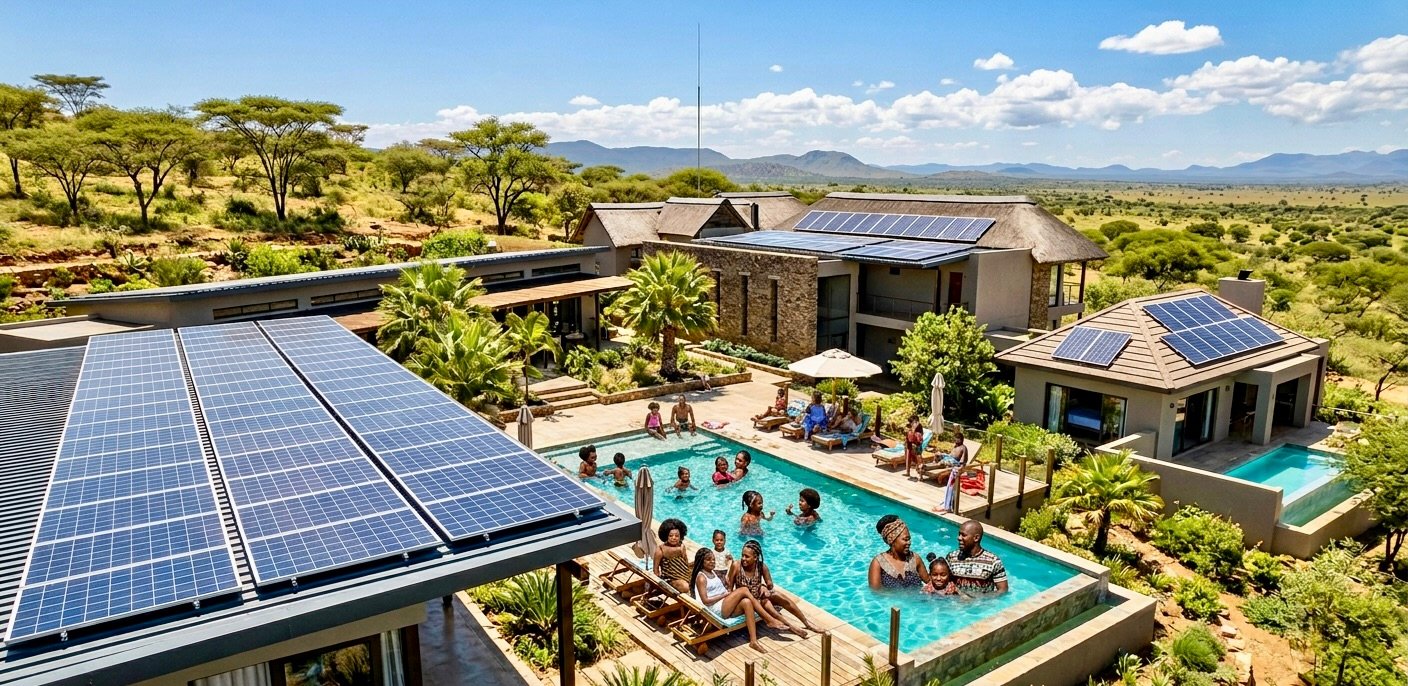

Solar-Powered Swimming Pools: A Smart Energy Solution for Homes and Hotels in Africa
How a solar swimming pool pump in Africa cuts costs, beats power outages, and keeps your water crystal clean.
Pool owners across Nigeria have one complaint that comes up constantly. The electricity bill. Or the generator cost. Or both.
A pool filtration pump runs every day. Often for 8 to 12 hours. In a country where grid power is unreliable and generator fuel prices have climbed sharply, that daily cost adds up fast. For hotels with commercial pools that never switch off, it is one of the largest operational expenses on the property.
There is a better way. And Africa is actually in the ideal position to take full advantage of it.
A solar swimming pool pump uses free sunlight to run the system that keeps your water clean. No fuel. No grid dependency. No surprise bills. And in a continent that receives some of the highest solar irradiance on Earth, it is not just a good idea. It is one of the most practical energy decisions a pool owner can make.
At Water Lords Pool & Aquatic Leisure Ltd, we integrate solar pump systems into new builds and existing pools across Nigeria. This guide explains why it matters, how it works, and what it costs.
Nigeria receives between 5 and 7 peak sun hours daily, depending on location. According to the International Renewable Energy Agency (IRENA), sub-Saharan Africa holds some of the world’s highest solar energy potential. Running a pool pump on that free resource is not just environmentally smart. It is financially smart.
How a Solar Pool Pump System Actually Works
The concept is straightforward. Solar panels convert sunlight into direct current (DC) electricity. That electricity powers a pump motor, which circulates water through the pool’s filtration and sanitation system. No grid connection needed. No generator required during daylight hours.
There are three main system configurations used across African markets today.
1. Direct-Drive DC Solar Pump Systems
This is the simplest setup. Solar panels feed power directly to a DC pump motor. The pump runs when the sun shines and stops when it does not. No inverter, no batteries. This works well in Nigeria and across sub-Saharan Africa precisely because sunshine hours are consistent and abundant. The tradeoff is that the system does not operate after dark or during extended power outages.
This configuration suits most residential pools where daytime filtration is sufficient.
2. Solar-Plus-Inverter AC Systems
Here, solar panels feed power through an inverter, which converts DC to alternating current (AC) to run a standard AC pool pump. This system can also draw from the grid or a generator when solar output is low, making it a flexible hybrid solution. It works well for pools that need continuous operation or for hotel properties where the pump must run around the clock.
3. Solar-Plus-Battery Storage Systems
Adding a battery bank allows the system to store excess solar energy during the day and use it at night or on cloudy days. This is the most energy-independent configuration and the most expensive upfront. For remote properties or commercial facilities in areas with very poor grid reliability, the investment often makes clear sense.
The Real Cost Savings: Solar vs. Generator
Let us talk numbers. This is where the solar argument becomes very concrete for Nigerian pool owners.
A standard residential pool pump draws between 750 watts and 1.5 kilowatts. Running it for 8 hours a day on a petrol generator, at current Nigerian fuel prices, costs roughly N3,000 to N6,000 per day in fuel alone. That is N90,000 to N180,000 per month. Over a year, you are spending N1.1 million to N2.2 million just on generator fuel to run the pump.
A solar pump system capable of running that same pump costs between N800,000 and N2.5 million to install. It has no ongoing fuel cost. Maintenance is minimal. And modern DC solar pumps are built to last 8 to 15 years.
The numbers speak for themselves.
| Cost Comparison | Generator-Powered Pump | Solar Pool Pump |
|---|---|---|
| Upfront installation cost | N200,000 – N600,000 (gen set) | N800,000 – N2.5M |
| Monthly fuel / energy cost | N90,000 – N180,000 | Near zero |
| Annual running cost | N1.1M – N2.2M | N30,000 – N80,000 (maintenance only) |
| Estimated payback period | N/A | 2 – 4 years |
| 5-year total cost estimate | N5.7M – N11.6M | N1.0M – N2.9M |
| CO2 emissions | Very high | Near zero |
| Noise | Significant | Silent |
| Dependence on fuel supply | High | None |
The math is hard to argue with. Over five years, a solar pool pump system saves most Nigerian homeowners between N4 million and N9 million compared to running the same pump on a generator. That is not a small number.
Why Africa Is the Perfect Continent for Solar Pool Pumps
Solar power works everywhere, but some places benefit more than others. Africa sits in a uniquely advantageous position for three reasons.
Abundant sunlight. Sub-Saharan Africa receives solar irradiance levels that are among the highest on Earth. According to the World Bank’s Global Solar Atlas, most of Nigeria receives between 1,600 and 2,200 kilowatt-hours of solar energy per square meter annually. That is enough to run a pool pump system comfortably for the majority of the year, even accounting for seasonal variation.
Unreliable grid power. In most African cities, grid electricity supply is inconsistent. In Nigeria, load shedding and power outages affect residential and commercial properties on a daily basis. A solar pool pump does not rely on NEPA. It runs on the sun, which is far more dependable than the national grid.
Rising fuel costs. Generator dependence is expensive and getting more expensive. As fuel prices track global oil markets and the naira fluctuates, the cost of keeping a generator running continues to climb. Solar eliminates that exposure entirely.
These three factors combine to make a solar swimming pool pump in Africa not just a sustainability choice but a straightforward economic one.
The Environmental Case: Why It Matters Beyond the Bill
Running a pool on a petrol generator produces significant carbon emissions. A typical 2kVA petrol generator running 8 hours a day releases approximately 2 to 4 kilograms of CO2 per hour. That adds up to several tonnes of carbon every year for a single pool.
The environmental context in Africa makes this increasingly important. Climate change is already affecting the continent more severely than most regions. Droughts, flooding, and shifting rainfall patterns are all intensifying. As the United Nations Environment Programme (UNEP) notes, Africa contributes the least to global emissions historically but bears some of the heaviest consequences.
Choosing solar for your pool is a small but meaningful act of responsibility. For hotels and resorts, it is also increasingly important to guests who care about environmental credentials when choosing where to stay.
The UN World Tourism Organization has identified energy efficiency as a core sustainability metric for hotels worldwide. Properties that can demonstrate measurable reductions in generator use and carbon emissions are better positioned for international certification, improved booking platforms rankings, and access to sustainability-focused investors and operators.
Why Hotels and Resorts Benefit Most
Residential pools run for a few hours a day. Hotel and resort pools often run continuously, 24 hours a day, 365 days a year. The filtration system never stops. The pump never rests. That means every day of generator fuel savings has an outsized impact at a commercial property.
A mid-size hotel pool pump drawing 1.5kW and running around the clock on a diesel generator costs N270,000 to N360,000 in fuel per month at current Nigerian prices. That is N3.2 million to N4.3 million per year. A solar-plus-inverter hybrid system that covers 70 percent of that need can save N2.2 million to N3 million annually from day one.
The return on investment timeline for hotels is often faster than for residential properties because of the higher baseline cost they are replacing. A well-designed commercial solar pool system typically pays back within 18 to 30 months for a hotel setting.
Beyond the numbers, a solar pool system gives hotel operators something else: energy independence. Pool filtration continues even during extended grid outages. Guests always swim in clean, properly circulated water. No power cut affects the pool experience.
What a Solar Pool Pump Installation Involves
The installation process is less complex than most people expect, especially when it is integrated into a new pool build. Here is how it typically works.
Step 1: Load Assessment
The first step is establishing the exact power requirement of your pool pump. This depends on pool volume, pipe diameter, filtration system type, and how many hours per day the pump needs to run. Water Lords assesses this at the design stage for new builds, or during a site audit for retrofit installations on existing pools.
Step 2: Solar Array Sizing
Based on the pump load and the site’s solar resource, the array is sized accordingly. For a typical residential pool pump drawing 1kW and running 8 hours a day in Lagos, a 3 to 4 panel array (400W per panel) is usually sufficient for daytime operation. Larger commercial pools require proportionally larger arrays.
Step 3: System Configuration Choice
Direct-drive DC systems are simpler and lower cost. Hybrid systems with grid or generator backup offer more flexibility. Battery storage adds resilience. The right choice depends on your usage pattern, budget, and how critical 24-hour operation is. We guide each client through this decision based on their specific situation.
Step 4: Installation and Commissioning
Panel mounting, wiring, pump installation or connection, and controller setup typically take 1 to 3 days for a residential system. Commercial systems may take longer depending on scope. Once commissioned, the system is tested across a full pump cycle before handover.
| System Type | Best For | Approx. Install Cost (N) | Battery Storage |
|---|---|---|---|
| Direct-Drive DC Solar Pump | Residential pools, daytime use | N800,000 – N1.5M | No |
| Solar-Plus-Inverter Hybrid | Residential and commercial, flexible | N1.2M – N2.8M | Optional |
| Solar-Plus-Battery System | Hotels, remote properties, 24hr use | N2.5M – N6M+ | Yes |
Choosing the Right Solar Pool Pump: What to Look For
Not all solar pool pumps are equal. Here is what experienced buyers look for when specifying a system in Nigeria or across the African market.
DC brushless motor technology. DC brushless motors are more efficient, run cooler, and last longer than older brush motor designs. They also vary their speed based on available solar power, which extends operating hours and reduces wear. This technology is now standard in quality solar pool pump products.
MPPT controller integration. A Maximum Power Point Tracking (MPPT) controller maximizes the energy extracted from your solar panels at any given light level. It is the difference between a system that runs efficiently and one that wastes potential. Any quality solar pool pump system should include MPPT.
IP68-rated pump housing. Pool environments are wet and corrosive. The pump unit should carry an IP68 ingress protection rating, meaning it is sealed against continuous water exposure.
Certified panels from reputable manufacturers. Solar panels from manufacturers with International Electrotechnical Commission (IEC) certification and proven field performance in tropical climates are worth specifying. Cheaper uncertified panels degrade faster in high-humidity, high-heat environments. The International Electrotechnical Commission (IEC) sets global safety and performance standards for photovoltaic systems.
Local technical support. This matters enormously in Nigeria. A system is only as good as the support available when something needs attention. Water Lords specifies and installs systems for which parts and technical support are accessible within the Nigerian market.
Eco-Friendly Pool Design: Beyond the Pump
Once you go solar on the pump, it is worth thinking about the full picture of sustainable pool design. Several other elements make a real difference.
Variable speed pumps. These adjust motor speed to match filtration demand rather than running at full power constantly. Combined with solar, they reduce energy consumption further and extend filter life. According to the U.S. Department of Energy, variable speed pumps can use up to 90 percent less energy than single-speed models over a full operating cycle.
Saltwater chlorination systems. These generate chlorine from dissolved salt, eliminating the need to buy and transport liquid chlorine or tablets regularly. They are gentler on swimmers, reduce plastic waste from chemical packaging, and cost less to maintain over time.
Pool covers. A quality pool cover reduces water evaporation by up to 95 percent. In a hot climate like Nigeria’s, evaporation is a major source of water loss. Covers also reduce chemical usage by protecting the water from UV degradation and airborne debris.
LED pool lighting. LED underwater lights use a fraction of the energy of older halogen fittings and last significantly longer. Paired with a solar or inverter system, LED lighting keeps your pool looking beautiful without adding meaningfully to your energy load.
Solar Pool System Advantages
- No recurring fuel cost
- Runs independently of the grid
- Silent operation
- Near-zero carbon emissions
- Low long-term maintenance
- Supports ESG and sustainability goals
- Payback within 2 to 4 years
Generator-Powered System Limitations
- High and rising daily fuel cost
- Dependent on fuel supply chain
- Loud and disruptive
- Significant CO2 and fumes
- Frequent servicing required
- No sustainability credentials
- Costs compound over time
Government Support and Incentives for Solar in Nigeria
Nigeria has taken steps to encourage solar adoption at both the national and state level. The Rural Electrification Agency (REA) runs programs that support distributed solar energy deployment across the country. The Nigerian Electricity Regulatory Commission (NERC) has frameworks in place for net metering and mini-grid licensing that are relevant to larger commercial solar installations.
Import duties on solar panels and components have been revised in recent years to encourage adoption. While the policy landscape continues to evolve, the direction of travel is clearly toward making solar more accessible and affordable across Nigeria.
For hotel operators and large residential developers, the Nigerian Export-Import Bank (NEXIM) and several development finance institutions active in Nigeria offer project finance products that can be applied to energy efficiency investments including solar pool systems.
Who Is Already Doing This in Nigeria?
Solar pool pump adoption in Nigeria is growing. Hotels in Lagos, Abuja, and Port Harcourt that have made the switch report consistent fuel savings and more reliable pool operations. Residential homeowners in Lekki, Ikoyi, and GRA estates are increasingly asking about solar integration when they commission new pool builds.
Water Lords has installed solar pump systems across residential and commercial projects in Lagos and beyond. The feedback from clients is consistent. After the initial investment, the operational experience is noticeably better. No fuel runs. No pump shutdowns during grid outages. No noise. Just a clean, running pool.
Whether you are building a new pool or want to retrofit an existing system, Water Lords can design and install a solar pump solution that fits your pool size, usage pattern, and budget. We handle the full process from system sizing to commissioning. And like all our projects, every solar installation comes with our standard support commitment.
Is Solar Right for Your Pool? A Simple Checklist
Solar is the right choice for most pool owners in Nigeria and across Africa. But here are the conditions under which it makes the most sense.
Your pool runs at least 6 hours a day. You currently use a generator or pay for NEPA electricity to run the pump. Your property has unshaded roof or ground space within reasonable distance of the equipment room. You plan to own the property for more than 3 years. You want the pool to keep running reliably regardless of power outages. If most of these apply to you, solar is worth a serious conversation.
We build pools, water features, and complete aquatic systems across Nigeria. We can design a solar pump system for your new build or retrofit one to your existing pool. Our team is based in Lekki, Lagos and serves clients nationwide.
Request a Free Consultation