
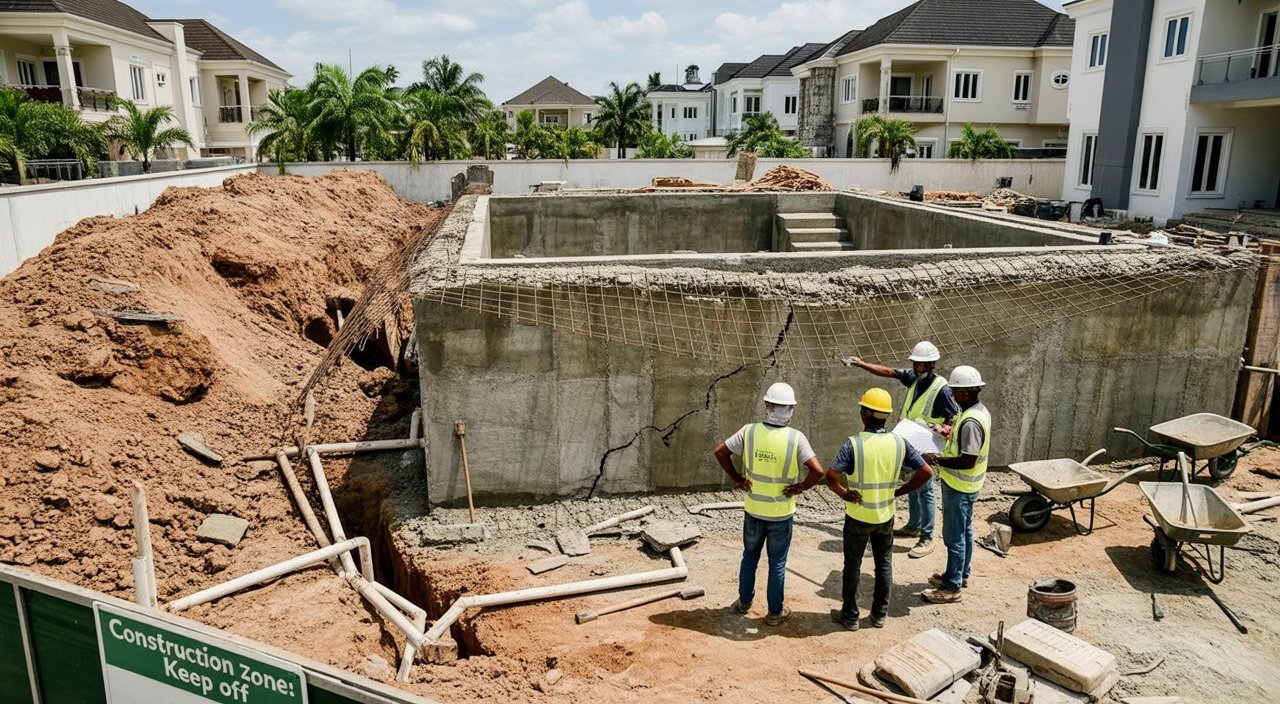

Common Swimming Pool Construction Mistakes and How to Avoid Them
What goes wrong, why it costs so much to fix, and what you must do before you break ground. Expert insight from Water Lords, Lagos.
Every week, someone somewhere in Nigeria starts building a swimming pool that will cause them serious regret within two years.
Not because pools are inherently risky. But because the decisions made in the weeks before construction begins, from site assessment to contractor selection to material specifications, determine almost everything that follows. Get those decisions right and you get a pool that gives you decades of enjoyment. Get them wrong and you get leaks, cracking tiles, green water, and repair bills that dwarf the original saving you thought you were making.
At Water Lords Pool & Aquatic Leisure Ltd, we have been called in to assess, remediate, and rebuild pools across Lagos and Nigeria that were poorly constructed by contractors who lacked the expertise or the integrity to do the job properly. The same mistakes appear repeatedly. This guide documents them clearly so you do not become the next person dealing with the consequences.
The majority of pool failures traced back to Water Lords for remediation were caused by decisions made before or during construction, not by maintenance failures afterward. Poor foundations, inadequate waterproofing, and wrong equipment sizing are almost impossible to fix cheaply once a pool is complete. Prevention is everything.
The Most Costly Swimming Pool Construction Mistakes
Each of the following mistakes has been documented from real pool builds in Nigeria. Some caused cosmetic damage. Others caused structural failure. All of them were preventable.
Choosing a Contractor Based on Price Alone
This is the most common and the most destructive error in Nigerian pool construction. A contractor who quotes significantly below everyone else is not offering value. They are signalling something important about how they intend to deliver the project.
Corners get cut on waterproofing. Structural steel is undersized or skipped entirely in sections. Cheap Chinese pump sets are installed instead of reputable brands. Tiles are fixed with the wrong adhesive for a wet environment. The pool looks complete on handover day. Six months later, the cracks appear. The tiles lift. The water level drops three centimetres every week.
The cost of remediation consistently exceeds the money saved on the original quote. We have seen clients spend N8 million to N15 million fixing a pool built by a contractor whose quote was N4 million cheaper than a reputable firm.
Collect at least three detailed, itemised quotes. Visit completed projects from each contractor. Ask for contact details of past clients and call them. Check registration with the Council for the Regulation of Engineering in Nigeria (COREN). Select based on demonstrated quality and track record, not the number at the bottom of the quote page.
Skipping the Soil and Site Assessment
A pool is a heavy, water-filled concrete structure sitting in the ground. The ground it sits in matters enormously. Many sites in Lagos and across Nigeria have challenging soil conditions. High water tables in areas like Lekki, Victoria Island, and parts of the mainland. Expansive clay soils that swell and contract with moisture changes. Reclaimed or poorly compacted fill land. Sandy coastal soils with low bearing capacity.
None of these are disqualifying. All of them require specific engineering responses. A structural foundation designed for stable soil on a high-water-table site is a pool that will move, crack, and leak. The structural work needed to address this adds cost, but it is cost that belongs in the original budget, not discovered partway through excavation.
Commission a geotechnical soil investigation before finalising your pool design. This typically costs N300,000 to N800,000 and provides the data your structural engineer needs to design the foundation correctly. The National Environmental Standards and Regulations Enforcement Agency (NESREA) also recommends environmental assessments for major construction projects to identify site-specific risks. Treat the soil test as non-negotiable, not optional.
Inadequate or Incorrect Waterproofing
Waterproofing is the most technically demanding element of pool construction and the one most frequently compromised by cost-cutting contractors. A pool shell that leaks does not just lose water. The escaping water saturates surrounding soil, creates hydrostatic pressure against the shell, undermines the foundation, and over time causes structural movement that cracks the concrete and dislodges tiles.
Waterproofing failures are rarely visible on the day of handover. They emerge gradually over months. By the time homeowners realise what is happening, the remediation scope is extensive and expensive. Full remediation typically requires draining the pool, removing tiles, hacking back renders, reapplying waterproof systems, re-tiling, and refilling. This commonly costs N3 million to N10 million depending on pool size.
Specify in writing the waterproofing system to be used, including brand, product, application method, and number of coats. Reputable waterproofing systems for pools include products certified to international standards. Ask your contractor to demonstrate that the waterproofing subcontractor has experience specifically in pool waterproofing, not general construction waterproofing. Inspect waterproofing application during construction, not only at completion. Insist on a water test before tiling begins.
Undersizing or Misspecifying the Filtration System
The filtration system is the engine of a swimming pool. It determines how effectively your water is cleaned, how long chemicals last, and how manageable your maintenance routine is. An undersized pump cannot turn over the pool water in the recommended timeframe. An incorrectly specified filter cannot handle the debris load for your pool volume and usage pattern.
The result is persistent water quality problems. Cloudy water that will not clear no matter how many chemicals you add. Algae blooms that return faster than you can treat them. Equipment that runs constantly and still underperforms. Pool owners who experience this often blame their maintenance routine when the real problem is a filtration system that was never adequate for the pool it was installed on.
The pool pump should be sized to turn over the total pool volume within 6 to 8 hours. This is the standard recommended by industry bodies including SPASA (the Swimming Pool and Spa Association) and is widely referenced across international pool construction standards. Ask your contractor to show the calculation for pump sizing based on your specific pool volume and pipe diameter. Request the technical specifications of the proposed pump and filter before signing off. Specify reputable brands. Pentair, Hayward, and Emaux are globally recognised names with established support networks.
Poor Pool Placement and Orientation
Where your pool sits on the plot and which direction it faces affects every aspect of your experience. A pool positioned directly under large trees will battle a constant rain of leaves, fruit, and organic debris that overwhelms filtration and raises phosphate levels year-round. A pool positioned in permanent shade in Nigeria’s climate can feel uncomfortably cool and encourages algae growth. A pool too close to the building’s foundation can create long-term structural complications for both.
Pool placement is also a drainage consideration. The surrounding area must drain away from the pool, not toward it. Pools positioned in low points on the property become collection points for surface runoff during every heavy rain.
Work with your contractor and ideally your architect to evaluate placement before finalising the design. Consider sun exposure, prevailing wind direction, proximity to trees and garden areas, drainage fall on the site, proximity to the house, and privacy sight lines. These decisions cannot be changed after construction without enormous cost. Give them the time they deserve at the design stage.
Underbudgeting and Scope Surprises
Many pool owners enter a construction project with a fixed budget based on a base quote that does not reflect the full scope of a complete pool. The contractor quotes for the shell and the basic equipment. The client discovers during construction that the quote did not include proper coping, a pump room structure, electrical connections, landscaping around the pool, or the power backup system to run the pump reliably.
Budget surprises mid-construction create pressure to cut corners. The homeowner, already committed and partly built, has fewer options. This is how cheap tiles get specified to replace the original choice, how lighting gets removed from the scope, and how the pool cover that was planned gets deferred indefinitely.
Require an itemised quote that specifies every element of the complete project, not just the shell and equipment. Items to confirm are included: coping and deck, electrical connections, equipment housing, lighting, water level management, landscaping, safety fencing, power backup provision, and permits. Add a 20 to 25 percent contingency on top of the total. That buffer protects you from the unexpected without compromising quality when surprises arise.
Building Without Permits
Pool construction is a structural development project that requires building permits in most Nigerian states. In Lagos, this means approval from the Lagos State Physical Planning Permit Authority. In Abuja, the Federal Capital Development Authority governs development approvals. Many homeowners, often encouraged by unscrupulous contractors who want to move fast, skip this step entirely.
The consequences range from fines and stop-work orders to forced demolition in serious cases. Unpermitted pools also create problems at the point of property sale, where due diligence can reveal unapproved structures that complicate the transaction. The permit process adds time and a modest cost. It is not optional.
Apply for the appropriate building permit before construction begins. In Lagos, engage LASPPPA early and build permit processing time into your project timeline. Permit fees for pools typically range from N100,000 to N500,000. A reputable contractor will advise you on this and help you assemble the required documentation. If a contractor actively discourages you from applying for a permit, treat it as a serious red flag.
Wrong Tile Choice for the Pool Environment
Not all tiles are suitable for swimming pools. Standard floor or wall tiles used in dry environments are not designed for continuous submersion in chemically treated water. They absorb moisture differently, react to chlorine and pH fluctuations, and use grout that is not formulated for permanent wet exposure. Pool tiles laid with standard adhesive in wet environments delaminate progressively as water penetrates behind the tile and the adhesive bond fails.
The result is tiles that begin lifting within one to three years, often in patches that then allow water to undermine adjacent tiles and accelerate the failure. Retiling a pool that has been tiled incorrectly is a significant undertaking that requires full drainage, tile removal, inspection of the underlying substrate for water damage, and complete re-tiling with correct materials.
Specify pool-rated tiles with low water absorption rates, installed with a flexible, waterproof tile adhesive (class C2S2 or higher per ISO 13007) and grouted with an epoxy or cement-based pool grout. Ask your contractor to confirm the tile, adhesive, and grout specifications in writing before work begins. Do not accept substitutions mid-project without written agreement.
No Written Contract or Warranty
A handshake and a quote document are not a contract. Countless pool disputes in Nigeria arise from the absence of a written agreement that clearly specifies scope, materials, timeline, payment milestones, and warranty terms. When problems emerge, and they eventually emerge in every construction project to some degree, the absence of a written contract leaves both parties with no clear reference point for resolution.
Clients end up absorbing costs they reasonably expected the contractor to cover. Contractors walk away from problems because there is nothing binding them to a remedy. The absence of documentation almost always benefits the contractor, not the client.
Insist on a written contract that includes: full scope of work with material specifications, a detailed payment schedule tied to construction milestones, a project timeline with key dates, a clear defects liability clause, and a warranty period with explicit terms on what is covered and for how long. Water Lords provides all of this as standard on every project, including a 1 to 3 year construction warranty and up to 6 months of complimentary maintenance after handover. A contractor who resists signing a detailed written contract is not a contractor you want building your pool.
Ignoring Power Supply for the Filtration System
In Nigeria, a pool without a reliable power solution for the pump is a pool that will struggle to maintain clean water. Grid power from NEPA is simply too intermittent to be the sole energy source for pool filtration. When the pump stops, circulation stops. Without circulation, chemical distribution stops working, debris settles, and algae conditions improve rapidly. A pool on intermittent grid power in Nigeria’s tropical climate will battle water quality problems consistently.
Many homeowners discover this problem after the pool is complete and the generator or solar infrastructure was never planned for. Retrofitting a dedicated power solution after construction is more expensive and more disruptive than integrating it from the start.
Plan your pool’s power supply at the design stage. Options include a dedicated generator connection, a solar pump system, or a solar-plus-inverter hybrid. Each has different upfront costs and running costs. Water Lords integrates solar pump systems into new builds and advises on the most cost-effective solution for each project. Read our detailed guide on solar pool pump options for Nigeria to understand the available configurations.
How to Spot a Bad Pool Contractor Before It Is Too Late
Most of the mistakes above are enabled by the wrong contractor. The ability to identify a poor contractor before signing any agreement is one of the most valuable skills a pool buyer can have.
A contractor who cannot or will not break down their quote by line item is hiding something. Materials, labour, equipment, and project management should all be separable. Lump-sum quotes make it impossible to verify what you are actually paying for.
Photos are easy to fake or borrow. Any contractor claiming experience in pool construction should be able to provide addresses of completed projects that you can physically visit and inspect. Inability or unwillingness to provide these references is a serious red flag.
Reputable contractors work on milestone-based payment schedules. Demanding 60 to 70 percent or more of the project cost upfront significantly reduces your leverage and removes their financial incentive to complete the work to a high standard. Never pay more than 30 to 40 percent at project commencement.
A contractor who does not offer a written warranty on their work does not believe their work will last. Period. Warranty terms should specify the duration, what is covered, and the process for claiming. Verbal assurances are worthless when problems emerge months after handover.
A contractor who tells you permits are unnecessary, a waste of money, or too much trouble is either ignorant of the regulatory framework or deliberately steering you around it for their own convenience. Either way, the legal and financial risk falls on you as the property owner.
Pool construction involves structural engineering, electrical work, and plumbing. The contracting firm should be able to demonstrate registration with COREN or relevant professional bodies. Unregistered operators have no professional accountability framework if the work fails.
The cheapest pool you build is often the most expensive one you own. The cost of construction is a one-time event. The cost of poorly built infrastructure is ongoing, compounding, and often unrecoverable.
Planning Mistakes That Cost Money Before Ground Is Broken
Some of the most damaging errors in pool construction happen before a single spade enters the ground. Decisions made at the planning and design stage shape every constraint that follows.
Designing Without Considering Maintenance Access
A pool tucked into a corner of the plot with no clear access path for maintenance equipment is a pool that becomes increasingly difficult and expensive to service over time. Professional pool cleaning equipment, water testing, and filter servicing all require physical access. A design that ignores this creates friction at every future maintenance visit. Ensure the pump room is accessible without moving outdoor furniture or climbing over structures. Ensure there is a surface path wide enough to bring equipment to poolside.
Choosing the Wrong Pool Size for the Plot
Overcapitalising a small plot with an oversized pool leaves no room for practical outdoor living around the pool. Undersizing a large plot produces a pool that looks lost in the available space. Pool design should begin with a clear understanding of the total outdoor area, the desired use pattern, and the surrounding landscape plan. The pool is one element of the outdoor environment, not the entire environment.
Failing to Plan for Water Features from the Start
Many clients who want to add a waterfall or decorative fountain after the pool is complete discover that retrofitting these elements is significantly more expensive than building them in from the start. Plumbing runs, structural supports, and pump sizing for water features are all easier and cheaper when integrated at the design stage. If there is any possibility you will want a water feature in the future, discuss it with your contractor during the design phase and at minimum lay the groundwork for later addition.
Every change made during construction costs more than the same change made at design stage. Changes made after construction costs many times more still. The time and money spent on thorough planning and design produces returns that compound through the entire life of the pool.
What Good Pool Construction Looks Like
Understanding mistakes is more useful when paired with a clear picture of what the right process looks like. Here is how a well-managed pool construction project unfolds.
| Stage | What a Good Contractor Does | Red Flag Behaviour |
|---|---|---|
| Site Assessment | Conducts or commissions soil test, evaluates drainage and orientation | Skips assessment, goes straight to excavation timeline |
| Design and Quote | Provides itemised quote with material specifications and 3D visualisation | Provides lump-sum quote only, no material breakdown |
| Permits | Advises on permit requirements and assists with application | Discourages permits or claims they are unnecessary |
| Contract | Issues detailed written contract with scope, timeline, milestones, and warranty | Works on verbal agreement or basic quote document only |
| Construction | Follows structural drawings, inspects waterproofing before tiling, allows client site visits | Discourages client visits, no documentation during build |
| Handover | Provides water test certificate, equipment manuals, maintenance schedule, and warranty documentation | Completes informally, no documentation, disappears after final payment |
| Post-Completion | Provides warranty period support and optional maintenance packages | Unreachable after final payment is collected |
Your Pre-Construction Checklist
Before you authorise any contractor to begin work on your pool, confirm that every item below has been addressed. This checklist reflects the minimum due diligence that protects your investment.
- ✓ Soil investigation has been completed and the structural design reflects the results
- ✓ Three or more itemised quotes have been collected and compared
- ✓ At least two completed projects from the chosen contractor have been physically visited
- ✓ Past clients have been contacted and provided positive references
- ✓ Contractor registration with COREN or relevant professional body has been verified
- ✓ Building permit application has been submitted to the relevant state authority
- ✓ A detailed written contract has been issued, reviewed, and signed
- ✓ Material specifications for waterproofing, tiles, adhesive, grout, and equipment are documented in the contract
- ✓ Payment schedule is milestone-based with no more than 35% paid upfront
- ✓ Warranty terms are written, specific, and signed
- ✓ Pool placement and orientation have been reviewed with consideration for drainage, trees, and sun exposure
- ✓ Power supply solution for the filtration system has been confirmed in the scope
- ✓ A 20 to 25 percent contingency budget has been set aside above the quoted total
The Cost of Getting It Wrong Versus Getting It Right
Pool construction mistakes are expensive in ways that go beyond repair bills. A pool with recurring water quality problems costs more to maintain chemically every month. A pool with a failing tile surface depreciates the visual quality of the entire property. A pool built without permits creates legal uncertainty over the property that affects its value and saleability. A pool with an inadequate filtration system will never hold clean water reliably, no matter how conscientious the maintenance routine.
Against each of these figures, the cost of doing it right from the start becomes extremely clear. A soil test for N500,000 that informs the structural design costs a fraction of the N5 million to N20 million it takes to remediate structural failure. A reputable contractor at N5 million more than the cheapest quote costs less than the N8 million to N15 million remediation we regularly see from failed cheap builds.
Water Lords Pool & Aquatic Leisure Ltd builds every pool from a foundation of proper site assessment, engineered structural design, specified waterproofing systems, reputable equipment, and full documentation. Our clients receive a written contract, a construction warranty of 1 to 3 years, and up to 6 months of complimentary post-completion maintenance. We do not offer the cheapest quote. We offer the best result. And that difference, as this article demonstrates, is worth every naira.
Water Lords Pool & Aquatic Leisure Ltd has delivered exceptional pool builds across Lagos and Nigeria for years. Every project starts with a free consultation, a site assessment, 3D design visualisation, a fully itemised quote, and a written warranty. Based in Lekki, Lagos. Serving all of Nigeria.
Request Your Free Consultation